Research Article | | Peer-Reviewed

Characteristics of Severe Dengue Infection with Compensated and Decompensated Shock in Children in a Tertiary Hospital in Bali, Indonesia

Received: 25 March 2025     Accepted: 2 April 2025     Published: 29 April 2025
Views:       Downloads:
Abstract

Severe dengue infection in Indonesia has a high mortality rate. This study aims to identify the characteristics of severe dengue infection with compensated and decompensated shock in children at a tertiary hospital in Bali, Indonesia. This study employs a descriptive retrospective design with a cross-sectional approach to identify the characteristics of severe dengue infection in children with compensated and decompensated shock at a tertiary hospital. Secondary data were utilized from children with dengue infection who were treated at Prof. Dr. I G. N. G. Ngoerah hospital from January to December 2023. The study population consists of children with dengue infection. The inclusion criteria include children aged 0–18 years diagnosed with severe dengue infection, while the exclusion criteria are children with incomplete medical record data. Prevalence of severe dengue infection in children was 36.9%, with 55.4% presenting with compensated shock. Of the 64 patients, the majority were children and adolescents (95.4%), with 70.8% being male. Most patients had good nutritional status (58.5%), no comorbidities (93.8%), and secondary dengue infection (89.2%). The median values of leukocytes, hemoglobin, hematocrit, platelets, and the neutrophil-to-lymphocyte ratio (NLR) in the compensated and decompensated shock groups were 5.25 and 6.1; 14.4 and 14.2; 42.6 and 43.1; 36 and 29; and 0.58 and 0.96, respectively. The mortality rate was 3.1%. Majority of children with severe dengue infection were children and adolescents, male, with good nutritional status, no comorbidities, and secondary infection. All cases of severe dengue manifested with significant plasma leakage, with a survival rate of 96.9%.

Published in American Journal of Pediatrics (Volume 11, Issue 2)
DOI 10.11648/j.ajp.20251102.16
Page(s) 63-71
Creative Commons

This is an Open Access article, distributed under the terms of the Creative Commons Attribution 4.0 International License (http://creativecommons.org/licenses/by/4.0/), which permits unrestricted use, distribution and reproduction in any medium or format, provided the original work is properly cited.

Copyright

Copyright © The Author(s), 2025. Published by Science Publishing Group

Keywords

Severe Dengue Infection, Dengue Shock, Children

1. Introduction
Dengue fever continues to pose a significant global health challenge, with a marked increase in cases among children. As of April 2024, the World Health Organization (WHO) reported over 7.6 million dengue cases worldwide, including more than 16,000 severe cases and over 3,000 deaths. Dengue fever represents a critical public health issue in Bali, Indonesia, marked by a significant rise in reported cases in recent years. Notably, in 2016, Bali recorded the highest incidence rate of dengue hemorrhagic fever (DHF) in the country, with 484.02 cases per 100,000 individuals. This high incidence is particularly alarming for children, who are among the most vulnerable to severe dengue outcomes.
Severe dengue is defined by the presence of one or more of the following conditions: (a) plasma leakage leading to shock (dengue shock) and/or fluid accumulation with or without respiratory distress, (b) severe bleeding (commonly gastrointestinal bleeding), and/or (c) significant organ impairment. Shock, classified into compensated and decompensated shock, is part of the hemodynamic alteration process. Factors influencing the severity of dengue infection in children include nutritional status, age, and history of previous infections. Children with poor nutritional status are at a higher risk of developing severe complications from dengue infection. Additionally, areas with high endemicity and rapid urbanization contribute to the increasing incidence of severe dengue cases. Therefore, a comprehensive understanding of the epidemiology and these risk factors is essential for the development of effective prevention strategies .
Further research is needed to identify the characteristics of patients with severe dengue infection, including those with compensated and decompensated shock. By raising public awareness and strengthening healthcare systems for early detection and case management, the incidence and mortality rates of severe dengue can be significantly reduced in Indonesia. Data reflecting the current dengue situation are expected to benefit stakeholders, ranging from policymakers to clinicians.
2. Materials and Methods
This study employs a descriptive retrospective design with a cross-sectional approach to identify the characteristics of children with severe dengue infection, including those with compensated and decompensated shock, in a tertiary referral hospital serving Eastern Indonesia. Secondary data were collected from children with severe dengue infection treated at Prof. Dr. I. G. N. G. Ngoerah Hospital from January to December 2023. The study was conducted from August to October 2024. The inclusion criteria consisted of children aged 0–18 years with severe dengue infection, while the exclusion criteria included children with incomplete medical records. A total sampling technique was utilized.
Severe dengue was defined by the presence of one or more of the following conditions: (a) plasma leakage causing shock (dengue shock) and/or fluid accumulation with or without respiratory distress, (b) severe bleeding (commonly gastrointestinal bleeding), or (c) significant organ impairment. Subject characteristics included referral status, age, sex, nutritional status, comorbidities, fever day upon arrival, day of shock onset, type of dengue infection, laboratory parameters (leukocyte count, hemoglobin, hematocrit, platelet count, and neutrophil-to-lymphocyte ratio [NLR]), length of hospital stay, complications, and outcomes. The independent variable in this study was maternal COVID-19 infection, defined as pregnant women who tested positive for SARS-CoV-2 via PCR testing. The dependent variable was preterm birth, defined as birth occurring at a gestational age of <37 weeks. The confounding variables included: Maternal age defined as the age of the mother during pregnancy. Parity defined as the number of previous pregnancies resulting in live births, categorized into parity 1 (primipara) and parity >1 (multipara). History of premature rupture of membranes (PROM) defined as the rupture of fetal membranes with amniotic fluid leakage through the vagina in the absence of labor contractions, as determined by the attending obstetrician.
Referral status was determined based on electronic medical records and categorized as nominal variables: (1) referred, if the patient was a referral case, and (2) non-referral, if the patient arrived without referral. Age was recorded as chronological age at the time of sampling and categorized as (1) infants (<1 year), (2) children (1–<12 years), and (3) adolescents (12–18 years). Sex was recorded as nominal data: (1) male and (2) female. Nutritional status was assessed based on anthropometric measurements (weight and length/height) obtained from electronic medical records and plotted on the World Health Organization (WHO) 2000 growth charts. Nutritional status was classified based on weight-for-length for children < 2 years, weight-for-height for children 2–<5 years, and body mass index-for-age for children aged 5 years and above. Categories included (1) malnourished, (2) well-nourished, and (3) overnourished. Fever day at admission and day of shock onset were determined from medical records. Comorbidity status was extracted from electronic medical records and categorized as (1) present, for patients with one or more comorbid conditions such as cardiac disease, epilepsy, anemia, renal disease, asthma, etc., and (2) absent, for those without comorbidities.
The type of dengue infection was categorized as (1) primary infection (positive IgM) or (2) secondary infection (positive IgG or both IgG and IgM). Laboratory values, including leukocyte count, hemoglobin, hematocrit, platelet count, and NLR, were obtained from laboratory records in the electronic medical system and presented as numerical data. Length of stay (LOS) was calculated as the duration between admission and discharge (survived or deceased) and recorded from medical records. Complications in children with severe dengue, such as massive bleeding and dengue shock syndrome, were obtained from electronic medical records and categorized as (1) present, for complications including dengue encephalopathy, electrolyte imbalance, pulmonary edema, transaminitis, disseminated intravascular coagulation (DIC), sepsis, pleural effusion, and others, and (2) absent, for cases without complications.
This study was approved by the Research and Development Unit (Litbang) of Prof. Dr. I. G. N. G. Ngoerah Hospital with ethical protocol number 2024.02.1.1011 from the Ethics Committee of the Faculty of Medicine, Udayana University/ Prof. Dr. I. G. N. G. Ngoerah Hospital, and research permit number DP.04.03/D.XVII.2.2.2/52669/2024. Data were analyzed using the Statistical Product and Service Solution (SPSS) software version 23.0 for Windows. Results were presented in tables, with categorical data expressed as percentages and numerical data as medians.
3. Results
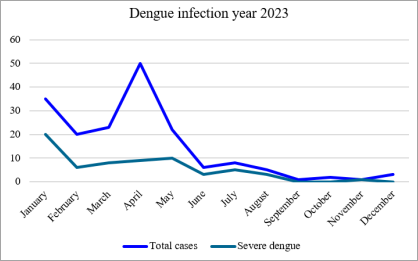
This study was conducted from January 2023 to December 2023, identifying a total of 176 pediatric dengue cases, of which 64 cases (36%) were classified as severe dengue and included in the study population. Dengue infections were observed throughout the year, with the highest incidence beginning early in the year and peaking in April. During this peak month, 50 severe dengue cases were recorded, accounting for 84% of all dengue cases, as illustrated in Figure 1. All patients with severe dengue were included as study subjects, with their characteristics detailed in Table 1.
The incidence of severe dengue was higher in males (70.3%), observed in both compensated and decompensated shock cases. Among the 64 patients, 4.6% were infants under 1 year of age, while the remainder were children and adolescents. Regarding nutritional status, the majority of children with severe dengue had a good nutritional status (53.8%), while 7.6% were undernourished, and 33.8% were classified as overweight. Fifty-one cases (79%) were referral cases.
Figure 1. Dengue infection (blue line) and severe dengue infection (red line) di Prof Dr dr IGNG Ngoerah Hospital, year 2023.
Table 1. Characteristics of Subjects and Clinical Presentation.

Characteristics

Group

Compensated shock 35 (54,6)

Decompensated shock 29 (44,6)

Referral (n, %)

Yes

24 (47,0)

27 (53)

No

11 (84,0)

2 (16,0)

Age (n, %)

Infant

1 (33,3)

2 (66,7)

Children

21 (48,8)

22 (51,2)

Teenager

13 (72,2)

5 (27,8)

Gender (n, %)

Male

27 (60,0)

18 (40,0)

Female

8 (42,1)

11 (57,9)

Nutritional status (n, %)

Undernourished

1 (20,0)

4 (80,0)

Well-nourished

25 (67,5)

12 (32,5)

Overweight

9 (40,9)

13 (59,1)

Comorbidities (n, %)

Yes

1 (25,0)

3 (75,0)

No

34 (56,7)

26 (43,3)

Day of fever on admission (n, %)

2

1 (100,0)

0 (0,0)

3

1 (50,0)

1 (50,0)

4

8 (36,3)

14 (63,7)

5

14 (63,6)

8 (36,7)

6

8 (57,1)

6 (42,9)

7

1 (100,0)

0 (0,0)

8

1 (100,0)

0 (0,0)

9

1 (100,0)

0 (0,0)

Day of fever on shock onset (n, %)

3

1 (50,0)

1 (50,0)

4

9 (39,1)

14 (60,9)

5

16 (61,5)

10 (38,4)

6

9 (69,2)

4 (30,8)

Type of dengue infection (n, %)

Primary

4 (66,7)

2 (33,3)

Secondary

30 (52,6)

27 (47,4)

Median of LOS (days)

3

4

Complications (n, %)

Present

3 (18,8)

13 (81,2)

Absent

32 (66,7)

16 (33,3)

Outcome (n, %)

Survived

35 (56,4)

27 (43,6)

Deceased

0 (0,0)

2 (100,0)

Comorbidities were present in 6.2% of patients, including febrile seizures plus (3.0%), epilepsy (1.5%), and anemia (1.5%). Serological testing indicated that secondary infections accounted for 89% of cases. The median duration of hospitalization was 3 days for compensated shock (range 1–7 days) and 4 days for decompensated shock (range 1–8 days). Laboratory values are detailed in Table 2, while 25% of patients experienced complications, as presented in Table 3.
Table 2. Laboratory Value Characteristics.

Median (range)

Group

Compensated shock 35 (54,6)

Decompensated Shock 29 (44,6)

Leukocytes (103/uL)

5,3 (1,1-15,4)

5,6 (2,2-14,0)

Haemoglobin (gram/dL)

14,6 (10,1-19,8)

14,3 (10,8-18,2)

Hematocrit (%)

43,1 (29,7-57,3)

43,2 (33,6-52,9)

Thrombocytes (103/uL)

38 (6-81)

36 (5-91)

NLR

0,97 (0,15-9,52)

0,97 (0,18-5,82)

Complications such as severe bleeding and significant organ involvement can increase the risk of mortality. The majority of patients survived, while 3.1% died in the decompensated shock group. The causes of death included septic shock and prolonged shock, each accounting for one patient (1.5%).
Table 3. Complications in Patients with Severe Dengue Infection.

Complications

Amount n (%)

Electrolyte imbalances

11 (64,7)

Phlebitis

1 (5,8)

Sepsis

1 (5,8)

Dengue encephalopathy

3 (17,6)

DIC

1 (5,8)

4. Discussion
This study describes the clinical characteristics and outcomes of severe dengue infection cases treated at Prof. Dr. I. G. N. G. Ngoerah Hospital in 2023. Dengue infection cases were reported throughout the year, with the highest incidence occurring early in the year and peaking in April, accounting for 28% of all treated dengue cases. Most severe dengue cases (80%) were referral. A previous study conducted at the same center in 2014 found a similar proportion, with 85% of cases being referrals from other healthcare facilities, and the peak incidence recorded in May. In many tropical regions, including Indonesia, the rainy season peaks from late in the year to early the following year (December–March). Heavy rainfall during this period creates stagnant water, providing ideal breeding grounds for Aedes aegypti mosquitoes, leading to a significant population increase a few weeks after the rainy season. Additionally, the warm and humid conditions in April–May further support the mosquito's life cycle.
Based on medical record data during the study period, 64 severe dengue cases were treated. The majority of these cases (79%) were referrals, consistent with findings by Fadilla et al (2020). A study conducted at the same center in 2017 reported that only 15% of severe dengue cases were referrals, indicating an increase in referral cases for severe dengue. The prompt diagnosis and management of dengue patients depend on the availability of healthcare facilities and public awareness of the importance of seeking medical assistance. Physicians are also expected to implement responsive monitoring efforts to prevent the progression of the disease to more severe forms of dengue infection. In the current study, this trend could be attributed to increased clinical awareness among physicians in primary healthcare facilities (e.g., community health centers or type B, C, or D hospitals) regarding dengue warning signs, leading to earlier referrals before patient conditions deteriorate. Alternatively, stricter referral protocols may have encouraged earlier referrals to ensure optimal care at facilities with greater capacity.
The proportion of severe dengue infection was higher in males (70%) compared to females (30%). According to data from the Ministry of Health in 2008, the incidence of dengue infection in the community is not influenced by gender. Similarly, 2022 data from the Ministry of Health reported comparable proportions of dengue cases in females (49%) and males (51%), with a male mortality rate of 45%. Several studies have suggested that boys and girls exhibit different immune responses to viral infections, making boys more susceptible to severe manifestations. Additionally, boys are more frequently engaged in outdoor activities, increasing their risk of mosquito bites and exposure to the dengue virus.
In this study, 4.5% of patients were under 12 months of age, with the youngest being 3 months old. Previous studies have also reported that the proportion of severe dengue infection in infants is lower compared to other age groups. Capeding et al (2010) documented an incidence of dengue infection in Southeast Asia among infants aged 3–8 months as 0.5 per 1,000 infants. Meanwhile, a recent 10-year study conducted in India found that 25% of dengue cases occurred in infants under 1 year of age. A review by Jain and Chaturvedi (2010) noted that maternal antibodies against the dengue virus, particularly IgG, provide temporary passive immunity during the first few months of life. Dengue shock syndrome is more commonly associated with secondary infections in older children and adults who have previously been infected with a different dengue serotype. Infants generally experience primary infections, which have a lower tendency to progress to severe dengue.
This study categorized nutritional status into malnourished, well-nourished, and overweight groups. In the compensated shock group, 72% were well-nourished, while in the decompensated shock group, 44% were overnourished. Children with overnutrition accounted for 33% of all severe dengue cases in this study, an increase from 11% reported in a previous study at the same center. A meta-analysis by Zulkipli et al. (2018) reported an odds ratio of 38% higher risk of severe dengue in obese children compared to non-obese children. Several factors contribute to this increased risk, including a more severe inflammatory response and complications associated with obesity itself. Obesity is linked to chronic inflammation, which leads to immune system dysregulation. This inflammatory state exacerbates the severity of dengue infection by increasing capillary permeability and plasma leakage, which are critical factors in the progression to severe dengue. Pro-inflammatory cytokines such as interferon-gamma (IFN-γ) and tumor necrosis factor-alpha (TNF-α) have been associated with endothelial dysfunction, further worsening clinical outcomes in obese patients.
Several comorbidities, including diabetes mellitus, obesity, hypertension, and asthma, are known to contribute to worse outcomes in dengue infection. In this study, 4 out of 64 patients (6%) had comorbidities, with a higher proportion observed in the decompensated shock group (4.6% vs. 1.5%). A 2018 study by Werneck et al in Brazil, involving dengue patients aged 9–45 years, reported an 11-fold increased risk of mortality in those with underlying comorbidities such as kidney disease, infections, pulmonary disease, and diabetes. A meta-analysis by Tsheten et al. identified diabetes and kidney disease as significant predictors of severe dengue.
Most patients presented to our hospital with fever lasting ≥4 days, consistent with previous studies conducted in Denpasar, Medan, and Surabaya. Some patients in both groups arrived on days 2 and 3 of fever, accompanied by warning signs, and developed shock during treatment. In this study, 40% of patients in the compensated shock group presented on day 5 of fever, while 48.3% of patients in the decompensated shock group arrived on day 4. Shock typically occurs between days 4 and 6 of fever, which is the critical phase of dengue infection. Most patients in this study were referrals from other healthcare facilities, emphasizing the need for clinicians to implement anticipatory monitoring to prevent worsening conditions given the wide spectrum of dengue infection. Particular attention should be paid to closely monitoring patients with warning signs, as these are strong indicators of potential progression to severe dengue. Three patients arrived at our hospital on days 7, 8, and 9 of fever. These patients were referrals who had developed shock at the referring hospitals, accompanied by complications.
Dengue shock is commonly observed during the critical phase, typically beginning between days 4 and 7 of illness. In some cases, particularly in patients with risk factors or severe dengue, plasma leakage and shock can occur earlier. Several factors, such as a high viral load, may trigger a hyperinflammatory response during the early stages of the disease, leading to more severe endothelial damage and earlier plasma leakage. Increased vascular permeability may also occur in secondary dengue infections due to antibody-dependent enhancement (ADE), wherein pre-existing non-neutralizing antibodies from a prior dengue infection facilitate increased viral uptake by immune cells. Certain groups, such as infants, the elderly, or individuals with underlying conditions (e.g., malnutrition, chronic diseases), are more likely to experience earlier shock and more severe plasma leakage. In some patients, the defervescence phase may occur as early as day 3, marking the transition to the critical phase where shock may arise due to increased vascular permeability. In our study, two patients experienced shock on day 3 of fever: one was an infant, and the other was an obese patient.
The supporting diagnostic tests performed in our patients included serology for anti-dengue IgG and IgM. NS1 testing was rarely conducted for confirming dengue cases, primarily due to cost factors, and because NS1 results do not alter the treatment approach. Anti-dengue serology is typically performed on day 6 of fever to determine infection status and can remain detectable for 60–90 days after onset. In this study, 89% of cases were secondary infections. This finding aligns with the theory that clinical manifestations of dengue are more severe in secondary infections.10 In the compensated and decompensated shock groups, 11.4% and 6.9% of patients, respectively, had primary infections. Several factors, such as high viremia levels during primary infections and certain viral strains (e.g., DENV-2 or DENV-3), may contribute to severe manifestations even in primary infections. Excessive release of pro-inflammatory cytokines, such as TNF-α, IL-6, and IFN-γ, can trigger a "cytokine storm" that damages endothelial cells, contributing to plasma leakage, hemoconcentration, and shock. Overactivation of dendritic cells, macrophages, and natural killer cells exacerbates inflammation and vascular permeability. Additionally, the dengue virus itself can directly damage endothelial cells, alongside inflammatory mediators.
Leukopenia, or low leukocyte counts, is a characteristic feature of dengue fever, commonly observed during the febrile phase and persisting into the critical phase due to bone marrow suppression by the dengue virus. In severe dengue, leukocyte levels may fluctuate in the presence of complications such as secondary infections (e.g., sepsis or nosocomial infections), which can lead to elevated leukocyte counts. Severe dengue is often associated with more pronounced leukopenia in the early phase compared to non-severe cases. In this study, laboratory parameters were compared at the onset of shock, revealing the lowest leukocyte counts of 1.1 and 2.2, with medians of 5.3 and 5.6 (in 103/dL) for the compensated and decompensated shock groups, respectively. A study by Yanti et al. (2021) found a significant association between the degree of leukopenia, particularly counts below 5.0 × 10³/uL, and the severity of dengue. Similarly, Risniati et al. (2011) reported that leukopenia could serve as a predictor of shock in children with dengue hemorrhagic fever. However, these findings contrast with a study by Tantracheewathorn et al. (2007), which found no significant association between leukopenia and dengue shock.
Polycythemia in children with severe dengue is a secondary phenomenon resulting from hemoconcentration caused by plasma leakage. In severe dengue, increased vascular permeability leads to plasma leakage into third spaces (e.g., pleural effusion, ascites), resulting in decreased plasma volume while red blood cell (RBC) levels remain constant within the intravascular compartment. In this study, the median hemoglobin levels in the compensated and decompensated shock groups were 14.6 and 14.3, respectively. The lowest hemoglobin level observed was 10.1 in the decompensated shock group, recorded in a 6-month-old infant. This patient also exhibited decreased mean corpuscular volume (MCV) and mean corpuscular hemoglobin concentration (MCHC), suggesting iron deficiency; however, further diagnostic evaluation was not performed.
An elevated hematocrit is a critical marker of plasma leakage during the critical phase of severe dengue, indicating hemoconcentration due to fluid leakage from capillaries into third spaces (e.g., pleural cavity and abdominal cavity). An increase of ≥20% from baseline is a diagnostic criterion for plasma leakage. Hematocrit levels can rise to 45–50% or higher, depending on the baseline values and the severity of fluid loss. In this study, the median hematocrit levels in the compensated and decompensated shock groups were 43.1% and 43.2%, respectively, with the highest hematocrit in the compensated shock group recorded at 57.3%. In compensated shock, plasma leakage into the third spaces occurs without significant blood loss, leading to hemoconcentration. In contrast, decompensated shock is characterized by a sudden drop in hematocrit during fluid administration, indicating internal bleeding or fluid overload.
The median platelet counts in this study were 38 and 36 (103/dL) for the compensated and decompensated shock groups, respectively, with the lowest values recorded at 6 and 5 in each group. Thrombocytopenia is a critical indicator often associated with disease severity. In compensated shock, platelet counts typically decrease progressively during the febrile phase, reaching their lowest levels during the critical phase. In decompensated shock, platelet counts remain persistently low, and the risk of bleeding is heightened due to thrombocytopenia and coagulopathy.
The median neutrophil-to-lymphocyte ratio (NLR) values in the compensated and decompensated shock groups were 0.97, with the lowest and highest ranges being 0.15–9.52 and 0.18–5.82, respectively. A study by Prijanto et al. (2023) reported a mean NLR of 0.43 ± 0.28 for dengue shock patients on day 4 of illness, with a range of 0.11–1.19. In contrast, the non-shock group had a mean NLR of 1.48 ± 0.65, with a range of 0.34–2.88. In this study, NLR values were obtained on the day of hospital admission (33.3% of compensated shock patients presented on day 5, and 31% of decompensated shock patients on day 4), introducing variability in determining the timing of white blood cell differentials. A study by Hartawan, which investigated children aged 5 years with acute onset fever (<72 hours) to diagnose dengue, used an NLR cut-off value of ≤1.75 based on ROC curve analysis with an AUC of 0.692. This yielded a positive predictive value of 52.6% and a negative predictive value of 82.8% for diagnosing dengue infection. In this context, a lower NLR value (≤1.75) is indicative of viral infections, particularly dengue.
A study conducted in Denpasar in 2014 reported that the length of hospital stay for dengue shock patients ranged from 1 to 9 days, with a mean of 3.6 days. Similarly, a study in Surabaya in 2020 found that two-thirds of patients with severe dengue infection were hospitalized for ≤5 days. In the current study, the median length of stay was 3 days (range 1–7 days) for children with compensated shock and 4 days (range 1–8 days) for those with decompensated shock, closely aligning with previous studies.
In this study, 33.8% of patients with severe dengue experienced complications, with the most common being electrolyte imbalance (16.9%), pleural effusion (4.6%), and dengue encephalopathy (4.6%). A 2017 study conducted at the same center reported that 27% of dengue shock patients had complications, including recurrent shock, pleural effusion, disseminated intravascular coagulation (DIC), and multiple organ failure (MOF). In the present study, 3.1% of patients deceased, with causes of death being septic shock and prolonged shock. This is a decrease compared to the previous study, which reported a mortality rate of 10% among dengue shock patients.
5. Study Limitations
This study can serve as a reference and foundation for future research with larger sample sizes to evaluate characteristics associated with severe dengue infection. The use of a prospective study design is recommended to ensure data quality and establish causal relationships between risk factors and severe dengue. A cohort study design could also be employed to monitor the clinical course of patients from disease onset to resolution. Additional research variables, such as dengue immunization status, environmental exposure, and biomarker parameters, should be included to enhance the comprehensiveness of future studies.
6. Conclusions
Most patients with severe dengue treated in this study were children and adolescents, predominantly male, with good nutritional status, and presented to the hospital on the 4th to 5th day of fever. The majority of cases were secondary infections, which are known to carry a higher risk of progressing to severe dengue. Most patients were referrals from primary or secondary healthcare facilities, highlighting the critical role of tertiary hospitals in managing severe dengue. The highest incidence of severe dengue occurred early in the year (April–May), correlating with the preceding rainy season. The mortality rate for severe dengue patients was relatively low (3.1%), with the most common complications being electrolyte imbalance, pleural effusion, and dengue encephalopathy. Differences in laboratory characteristics were observed between compensated and decompensated shock groups, such as lower platelet counts and higher NLR in patients with decompensated shock, although these differences have not been statistically tested.
Abbreviations

ADE

Antibody-Dependent Enhancement

DENV

Dengue Virus

DHF

Dengue Hemorrhagic Fever

DIC

Disseminated Intravascular Coagulation

HCT

Hematocrit

HGB

Hemoglobin

IFN-γ

Interferon-gamma

IL-6

Interleukin-6

IQR

Interquartile Range

LOS

Length of Stay

MCV

Mean Corpuscular Volume

MCHC

Mean Corpuscular Hemoglobin Concentration

MOF

Multiple Organ Failure

NLR

Neutrophil-to-Lymphocyte Ratio

NS1

Non-Structural Protein 1

PLT

Platelet

ROC

Receiver Operating Characteristic

SPSS

Statistical Product and Service Solution

TNF-α

Tumor Necrosis Factor-alpha

WHO

World Health Organization

Acknowledgments
We thank Departement of Pediatrics medical school of Udayana University, Ngoerah Hospital.
Author Contributions
Putu Satya Pratiwi: Data curation, Formal Analysis, Investigation, software, visualization, writing-original draft
I Made Gde Dwi Lingga Utama: Conceptualization, Resources, Methodology, Validation, supervision, writing-review & editing
I Wayan Gustawan: Conceptualization, Resources, Methodology, Validation, supervision, writing-review & editing
I Made Yulllyantara Saputra: Conceptualization, Resources, Methodology, Validation, supervision, writing-review & editing
Funding
This work is not supported by any external funding.
Data Availability Statement
The data supporting the outcome of this research work has been reported in this manuscript.
Conflicts of Interest
The authors declare no conflicts of interest.
References
[1] World Health Organization. 2009. “Dengue for diagnosis, treatment and control”. Retrieved (
[2] Khanam A, Gutierrez-Barbosa H, Lyke KE, Chua JV. 2022. “Immune-mediated pathogenesis in dengue virus infection.” Virus; 14: 1-5.
[3] Indarini PF, Gustawan IW, Utama IMGDL. 2017. ”Karakteristik klinis dan luaran pasien anak dengan sindroma syok dengue di RSUP Sanglah tahun 2014.” Medicina; 48(2): 103-107.
[4] Fadilla AN, Husada D, Utomo B. 2020. ”Epidemiology of children with severe dengue infection in Dr. Soetomo general hospital.” J Indon Med Assoc; 70(4): 1-5.
[5] Capeding RZ, Brion JD, Caponpon MM, Gibbons RV, Jarman RG, Yoon IK, Libraty DH. 2001. “The incidence, characteristics, and presentation of dengue virus infections during infancy.” Am J Trop Med Hyg; 82: 330–336.
[6] Dash N, Aby E, Kumar M, Abraham AM, Rose W. 2021. “Infant dengue a 10-year experience from a tertiary center in South India.” Am J Trop Med Hyg; 105(2): 1-7.
[7] Jain A, Chaturvedi UC. 2010. “Dengue in infants: an overview.” FEMS Immunol Med Microbiol; 59(2): 1-6.
[8] Zulkipli MS, Dahlui M, Jamil N, Peramalah D, Wai HVC, Bulgiba A, Rampal S. 2018. “The association between obesity and dengue severity among pediatric patients: A systematic review and meta-analysis.” Negl Trop Dis; 12(2): 1-5.
[9] Sekaran SD, Liew ZM, Yam HC, Raju CS. 2022. “The association between diabetes and obesity with dengue infections.” Diabetol Metab Syndr; 14: 1-10.
[10] Werneck GL, Macias AE, Mascarenas C, Coudeville D, Morley D, Recamier V, et al. 2018. “Comorbidities increase in-hospital mortality in dengue patients in Brazil.” Mem Inst Oswaldo Cruz; 113(8): 1-5.
[11] Yanti EL, Suryawan IWB, Widiasa M. 2021. “Hubungan derajat leukopenia terhadap tingkat keparahan penyakit Demam Berdarah Dengue (DBD) pada pasien anak yang dirawat di Ruang Kaswari RSUD Wangaya, Denpasar, Indonesia.” Intisari Sains Medis; 12(3): 908-911.
[12] Risniati Y, Tarigan LH, Tjitra E. 2011. ”Leukopenia sebagai prediktor terjadinya sindrom syok dengue pada anak dengan demam berdarah dengue di RSPI Prof. dr. Sulianti Saroso.” Media Litbang Kesehatan; 21(3): 96-103.
[13] Tantracheewathorn T, Tantracheewathorn S. 2007. “Risk factors of dengue shock syndrome in children.” J Med Assoc Thai; 90(2): 272-277.
[14] Tsheten T, Clements ACA, Gray DJ, Adhikary RK, Furuya-Kanamori L, Wangdi K. 2021. “Clinical predictors of severe dengue: a systematic review and meta-analysis.” Infect Dis Poverty; 10: 123: 1-10.
[15] Alexander N, Balmaseda A, Coelho IC. 2011. “Multicentre prospective study on dengue classification in four South-East Asian and three Latin American countries.” Trop Med Int Health; 16: 936–48.
Cite This Article
  • APA Style

    Pratiwi, P. S., Utama, I. M. G. D. L., Gustawan, I. W., Saputra, I. M. Y. (2025). Characteristics of Severe Dengue Infection with Compensated and Decompensated Shock in Children in a Tertiary Hospital in Bali, Indonesia. American Journal of Pediatrics, 11(2), 63-71. https://doi.org/10.11648/j.ajp.20251102.16

    Copy | Download

    ACS Style

    Pratiwi, P. S.; Utama, I. M. G. D. L.; Gustawan, I. W.; Saputra, I. M. Y. Characteristics of Severe Dengue Infection with Compensated and Decompensated Shock in Children in a Tertiary Hospital in Bali, Indonesia. Am. J. Pediatr. 2025, 11(2), 63-71. doi: 10.11648/j.ajp.20251102.16

    Copy | Download

    AMA Style

    Pratiwi PS, Utama IMGDL, Gustawan IW, Saputra IMY. Characteristics of Severe Dengue Infection with Compensated and Decompensated Shock in Children in a Tertiary Hospital in Bali, Indonesia. Am J Pediatr. 2025;11(2):63-71. doi: 10.11648/j.ajp.20251102.16

    Copy | Download

  • @article{10.11648/j.ajp.20251102.16,
      author = {Putu Satya Pratiwi and I Made Gede Dwi Lingga Utama and I Wayan Gustawan and I Made Yullyantara Saputra},
      title = {Characteristics of Severe Dengue Infection with Compensated and Decompensated Shock in Children in a Tertiary Hospital in Bali, Indonesia
    },
      journal = {American Journal of Pediatrics},
      volume = {11},
      number = {2},
      pages = {63-71},
      doi = {10.11648/j.ajp.20251102.16},
      url = {https://doi.org/10.11648/j.ajp.20251102.16},
      eprint = {https://article.sciencepublishinggroup.com/pdf/10.11648.j.ajp.20251102.16},
      abstract = {Severe dengue infection in Indonesia has a high mortality rate. This study aims to identify the characteristics of severe dengue infection with compensated and decompensated shock in children at a tertiary hospital in Bali, Indonesia. This study employs a descriptive retrospective design with a cross-sectional approach to identify the characteristics of severe dengue infection in children with compensated and decompensated shock at a tertiary hospital. Secondary data were utilized from children with dengue infection who were treated at Prof. Dr. I G. N. G. Ngoerah hospital from January to December 2023. The study population consists of children with dengue infection. The inclusion criteria include children aged 0–18 years diagnosed with severe dengue infection, while the exclusion criteria are children with incomplete medical record data. Prevalence of severe dengue infection in children was 36.9%, with 55.4% presenting with compensated shock. Of the 64 patients, the majority were children and adolescents (95.4%), with 70.8% being male. Most patients had good nutritional status (58.5%), no comorbidities (93.8%), and secondary dengue infection (89.2%). The median values of leukocytes, hemoglobin, hematocrit, platelets, and the neutrophil-to-lymphocyte ratio (NLR) in the compensated and decompensated shock groups were 5.25 and 6.1; 14.4 and 14.2; 42.6 and 43.1; 36 and 29; and 0.58 and 0.96, respectively. The mortality rate was 3.1%. Majority of children with severe dengue infection were children and adolescents, male, with good nutritional status, no comorbidities, and secondary infection. All cases of severe dengue manifested with significant plasma leakage, with a survival rate of 96.9%.
    },
     year = {2025}
    }
    

    Copy | Download

  • TY  - JOUR
    T1  - Characteristics of Severe Dengue Infection with Compensated and Decompensated Shock in Children in a Tertiary Hospital in Bali, Indonesia
    
    AU  - Putu Satya Pratiwi
    AU  - I Made Gede Dwi Lingga Utama
    AU  - I Wayan Gustawan
    AU  - I Made Yullyantara Saputra
    Y1  - 2025/04/29
    PY  - 2025
    N1  - https://doi.org/10.11648/j.ajp.20251102.16
    DO  - 10.11648/j.ajp.20251102.16
    T2  - American Journal of Pediatrics
    JF  - American Journal of Pediatrics
    JO  - American Journal of Pediatrics
    SP  - 63
    EP  - 71
    PB  - Science Publishing Group
    SN  - 2472-0909
    UR  - https://doi.org/10.11648/j.ajp.20251102.16
    AB  - Severe dengue infection in Indonesia has a high mortality rate. This study aims to identify the characteristics of severe dengue infection with compensated and decompensated shock in children at a tertiary hospital in Bali, Indonesia. This study employs a descriptive retrospective design with a cross-sectional approach to identify the characteristics of severe dengue infection in children with compensated and decompensated shock at a tertiary hospital. Secondary data were utilized from children with dengue infection who were treated at Prof. Dr. I G. N. G. Ngoerah hospital from January to December 2023. The study population consists of children with dengue infection. The inclusion criteria include children aged 0–18 years diagnosed with severe dengue infection, while the exclusion criteria are children with incomplete medical record data. Prevalence of severe dengue infection in children was 36.9%, with 55.4% presenting with compensated shock. Of the 64 patients, the majority were children and adolescents (95.4%), with 70.8% being male. Most patients had good nutritional status (58.5%), no comorbidities (93.8%), and secondary dengue infection (89.2%). The median values of leukocytes, hemoglobin, hematocrit, platelets, and the neutrophil-to-lymphocyte ratio (NLR) in the compensated and decompensated shock groups were 5.25 and 6.1; 14.4 and 14.2; 42.6 and 43.1; 36 and 29; and 0.58 and 0.96, respectively. The mortality rate was 3.1%. Majority of children with severe dengue infection were children and adolescents, male, with good nutritional status, no comorbidities, and secondary infection. All cases of severe dengue manifested with significant plasma leakage, with a survival rate of 96.9%.
    
    VL  - 11
    IS  - 2
    ER  - 

    Copy | Download

Author Information